
🌿 Join Lushly to get full access
Save plants to your garden, get AI care advice, buy & sell locally, and more.
Plant Summary
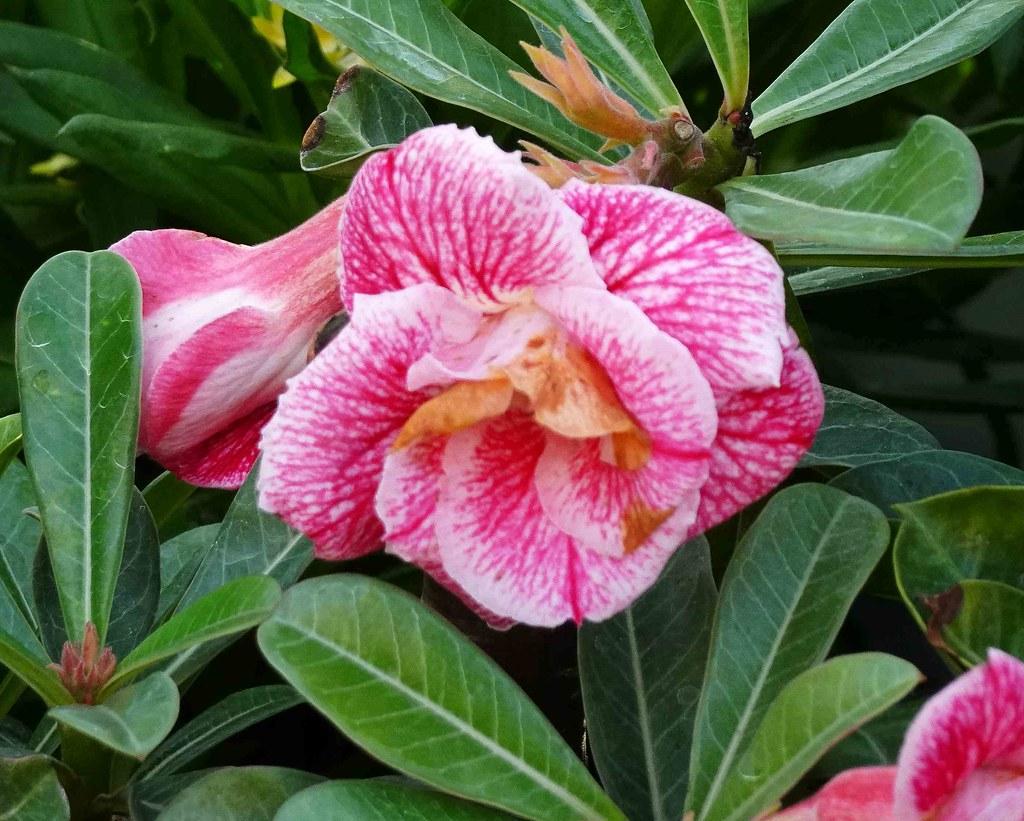
desert rose
Adenium obesum
Click any classification to search for similar plants
Adenium obesum, commonly known as the Desert Rose, is a striking succulent native to arid regions of Africa and the Arabian Peninsula. This plant is renowned for its swollen, water-storing trunk and vibrant, trumpet-shaped flowers that bloom in shades of red, pink, white, and yellow. Its unique appearance and resilience make it a popular choice for both indoor and outdoor cultivation. Botanical Characteristics The Desert Rose typically grows to a height of 3 to 6 feet (90 to 180 cm) and spreads 1 to 3 feet (30 to 90 cm) wide.
Its glossy, dark green leaves complement the striking flowers, creating a visually appealing contrast. The plant's swollen base, known as the caudex, serves as a water reservoir, enabling it to thrive in dry conditions. Flowering occurs from spring to autumn, with blooms that can be single, double, or even triple in form. (edis.
ifas. ufl. edu) Care Instructions Watering: Adenium obesum is susceptible to root rot if overwatered. During the growing season (spring and summer), water the plant thoroughly when the top inch of soil feels dry to the touch.
In cooler months (fall and winter), reduce watering frequency, allowing the soil to dry out completely between waterings. Always ensure the pot has adequate drainage to prevent waterlogging. (edis. ifas.
ufl. edu) Sunlight: This plant thrives in bright, direct sunlight. It requires at least 6 hours of sunlight daily to encourage blooming and maintain healthy growth. If grown indoors, place it near a south-facing window where it can receive ample sunlight.
(livetrends. com) Soil: Use a well-draining soil mix that mimics the plant's native habitat. A combination of cactus mix and perlite or sand works well. Ensure the pot has adequate drainage holes to prevent waterlogging, which can be detrimental to the plant's health.
(jptcp. com) Temperature: Adenium obesum prefers warm temperatures, ideally between 70°F and 90°F (21°C to 32°C). It is sensitive to cold and should be protected from temperatures below 50°F (10°C). During colder months, bring the plant indoors or ensure it is in a sheltered location.
(livetrends. com) Additional Care Tips Fertilization: During the active growing season, feed Adenium obesum with a balanced, diluted fertilizer every 2–4 weeks. Use a fertilizer formulated for succulents or cacti. Reduce or stop fertilizing during the dormant season when the plant's growth slows down.
(jptcp. com) Pruning: Pruning is important to shape the plant, remove dead or diseased growth, and encourage branching. Prune after flowering or during the growing season. Always use clean, sharp tools to avoid damaging the plant.
(jptcp. com) Repotting: Adenium obesum has a slow growth rate and doesn't require frequent repotting. Repot when the plant becomes root-bound or the potting mix has deteriorated. Spring is generally the best time for repotting.
(jptcp. com) Caution Be cautious, as Adenium obesum is in the dogbane family, with all species bleeding a poisonous sap that can irritate skin and mucous membranes. (maysgardenseed. com) By following these care guidelines, you can cultivate a healthy and vibrant Desert Rose that will reward you with its stunning blooms year after year.
Want to buy this plant?
Find local sellers and online retailers near you
Load additional realistic photos, blog articles and videos about desert rose.
Photos are AI-generated, articles and videos are curated links. Uses 10 seeds.
Please log in to use this feature.
Ask the Community
Get advice from fellow plant lovers
Install Lushly App
Get instant access from your home screen - works offline!
Powered by Lushly Plants © and Living Intent ™
Copyright Lushly Plants ©. All Rights Reserved 2026